

Process
Investigation

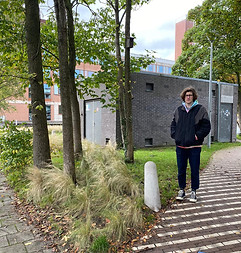


The investigation process of my product gave me an opportunity to dig deep into my family roots and my family members' footsteps in Amsterdam. In many ways it was a research of my Jewish history. I was brainstorming traditional recipes and choosing those that would best fit and be included in my book, feeling each of those chosen recipes deserved a stage performance in my book.
My resources were very well varied, including books, websites, a personal interview with a jewish cook here in Amsterdam and of course the research of stories, personal diaries and old photos of my Dutch family's life in Amsterdam in the 1940s. I heard and read about their life, how they moved between 40 different hiding places during the war, shivering stories of bravery and survival only for being Jewish. I found out about our family's famous pickle business and visited locations where the old factory used to be and where my family lived during WWII and before they moved to Israel to settle there in the 1950s (Photos 1 and 2).
My favourite part of the investigation process was interviewing Esther Erwteman, a Dutch jewish cook who just recently published her own Jewish cookbook “NOSH” and kindly invited me into her kitchen (Photos 3 and 4). I found this meeting most intriguing, as she was able to give me tips and advice on my ideas for my cookbook, explain how far back some of these recipes go in the community, why one publishes a Jewish cookbook to a non Jewish audience and discuss the importance of keeping our traditions.
I was able to educate myself a little more about what it means to be Jewish growing up in a non Jewish dutch society these days. It is so interesting how much we can learn and feel through the tastes and smells of our traditional food. How much have we learnt from those war days and how much have we progressed and how important it is to keep our memories and those warm-hearted traditions alive.
Planning

My planning started with choosing those traditional recipes that would end up in my 'shortlist' of the 'must have dishes on every Jewish dining table'. This was not an easy task to say the least. Being Jewish and having family in Israel, every household there is a collection of so many immigrants from such varied countries and backgrounds. Different foods, different tastes and smells. There is no single Jewish menu that every Jewish home follows. A European kitchen is very different to a Tunisian or Moroccan one. Hence, I had to concentrate on those dishes that create my own family kitchen and my own European background.
I wanted to include those special recipes we eat on every weekly Shabbat table but also one for each important jewish holiday. I started with a much longer list of recipes which I soon realised would be way too much to accommodate. After discussions with my supervisor, I narrowed down the recipes to a total of 12, despite it being double the limit I originally set in my criteria with the advice of my supervisor, I feel each of these magic 12 recipes have a presence and an important role in my collection. It was really positive to exceed even my own expectations.
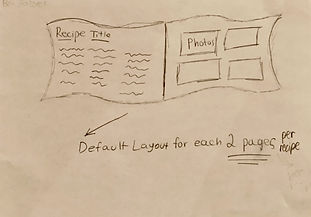
I made some sketches of how I see the vision of the book in my mind (opposite pictures). Of course that was before I even started cooking or taking photographs of the dishes, but at least it was start of a process in my head. It gave me a vision to follow through.
Last, but definitely not least, was the star of the show- the Challah. It is such an important part of every meal, every holiday, every Friday dinner- I had to give it the stage that it deserves by naming my book after it. The Challah is really symbolic, the one dish/recipe every single Jew in the world would eat and be accustomed with, wherever they come from on the globe. It really ties all of us Jews together.
Taking Action


Practical phase- I began experimenting in the kitchen. I tried out every single recipe in our own kitchen. Not many disasters I must admit as most of these recipes are very common and regular in our home kitchen and on our weekly dining table but some are indeed quite special which we had to recreate especially for this project. With every recipe we recreated, my parents had so many stories to tell on how this particular dish was served in their home or how spicy that dish would be made by that member of the family. It was a real pleasure and such an educating process for me, and I could tell also for my parents.
This followed by taking images of every dish we made, the dishes had to be presented and plated well so that photographs would look good and professional to be included in my book, opposite every outlined recipe. This was a pedantic phase. Patience is required and a lot of attention to details. This was a relatively long process and I made sure to spread it over a good few weeks. After all, a lot of eating was involved as well!
Following cooking, photographing and tasting all the recipes, it was time to design, write, edit and finally print the book. That took a lot of time and effort. Not only because I set myself to print a real book with a professional look and feel of a published piece of work, but also because the writing and editing of a book on its own takes a real skill and is extremely time consuming. I also had to stick to a strict deadline, making sure that the final published product will be printed and sent back to me in time to hand it in.